The Residence Time for Water in Any of Earth's Principal Reservoirs Can Be Calculated by Dividing
5.3 Salinity Patterns
All of the salts and that dissolve in seawater contribute to its overall . Salinity of seawater is normally expressed as the grams of salt per kilogram (thousand thousand) of seawater. On boilerplate, about 35 1000 of common salt is nowadays in each 1 kg of seawater, so we say that the boilerplate salinity of the ocean salinity is 35 parts per chiliad (ppt). Note that 35 ppt is equivalent to 3.5% (parts per hundred). Some sources at present utilise (PSU) to limited salinity values, where 1 PSU = 1 ppt. The units are not included, so we can refer simply to a salinity of 35.
Many different substances are dissolved in the ocean, but six ions incorporate about 99.4% of all the dissolved ions in seawater. These six are (Table five.3.1):
Table 5.3.1 The half dozen major ions in seawater
| chiliad/kg in seawater | % of ions by weight | |
|---|---|---|
| Chloride Cl- | 19.35 | 55.07% |
| Sodium Na+ | 10.76 | thirty.half dozen% |
| Sulfate Theniv ii- | two.71 | vii.72% |
| Magnesium Mg2+ | ane.29 | three.68% |
| Calcium Ca2+ | 0.41 | 1.17% |
| Potassium K+ | 0.39 | 1.1% |
| 99.36% |
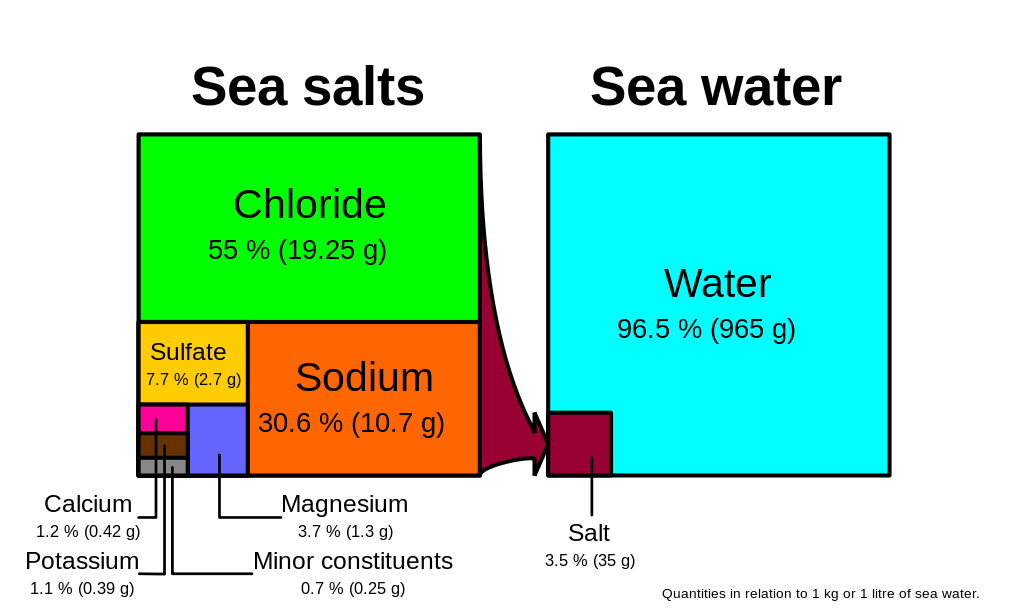
Chloride and sodium, the components of tabular array salt (sodium chloride NaCl), make up over 85% of the ions in the ocean, which is why seawater tastes salty (Figure 5.three.1). In improver to the major constituents, there are numerous minor constituents; radionucleotides, organic compounds, metals etc. These minor constituents are found in concentrations of ppm (parts per one thousand thousand) or ppb (parts per billion), unlike the major ions that are far more abundant (ppt) (Table 5.iii.ii). To put this into perspective, one ppm = i mg/kg, or the equivalent of i teaspoon of sugar dissolved in xiv,000 cans of soda. one ppb = 1 μg/kg, or the equivalent of one teaspoon of a substance dissolved in 5 Olympic-sized pond pools! These small constituents represent numerous substances, but together they make up less than one% of the ions in the seawater. Some of these may be important equally minerals and trace elements vital to living organisms, simply they don't have much impact on the overall salinity. But given the vast size of the oceans, even materials institute in trace affluence can correspond fairly large reservoirs. For instance gold is a trace element in seawater, found in concentrations of parts per trillion, nevertheless if you could extract all of the gold in just one km3 of seawater, it would exist worth about $20 million!
Table 5.3.2 Concentrations of some pocket-size elements in seawater
| g/kg in seawater | g/kg in seawater | ||
|---|---|---|---|
| Carbon | 0.028 | Iron | 2 x 10⁻⁶ |
| Nitrogen | 0.0115 | Manganese | 2 ten ten-7 |
| Oxygen | 0.006 | Copper | 1 x ten-7 |
| Silicon | 0.002 | Mercury | three 10 x-8 |
| Phosphorous | 6 x x-five | Golden | four 10 10-9 |
| Uranium | 3.two x 10-6 | Lead | v 10 10-10 |
| Aluminum | 2 x 10-vi | Radon | 6 10 10-19 |
Because the six in seawater comprise over 99% of the full salinity, changes in abundance of the minor constituents have little effect on overall salinity. Furthermore, the states that even though the absolute of body of water water might differ in dissimilar places, the relative proportions of the six major ions within that water are always constant. For example, no matter the total salinity of a seawater sample, 55% of the total salinity will be due to chloride, thirty% due to sodium, and so on. Since the proportion of these major ions does not alter, nosotros call these .
Given these constant proportions, in order to calculate full salinity you can simply measure the concentration of just one of the major ions and utilise that value to calculate the rest. Traditionally chloride has been the ion measured because it is the most abundant, and thus the simplest to measure accurately. Multiplying the concentration of chloride past one.8 gives the full salinity. For instance, looking at Figure five.3.1, 19.25 yard/kg (ppt) chloride 10 ane.8 = 35 ppt. Today, for rapid measurements of salinity, electric conductivity is oft used rather than determining chloride concentrations (see box below).
There are a number of methods bachelor for measuring the salinity of water. The nigh precise measurements employ directly chemical analysis of the seawater in a lab setting, but in that location are a number of ways to become immediate salinity measurements in the field. For a quick judge of salinity, a manus-held refractometer tin be used (right).
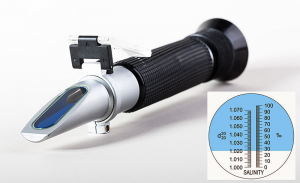
This instrument measures the degree of angle, or refraction, of low-cal rays as they pass through a fluid. The greater the corporeality of dissolved salts in the sample, the greater the caste of light refraction. The observer traps a driblet of water on the blue screen, and looks through the eyepiece. The dividing line between the bluish and white sections of the scale (inset) can be used to read the salinity.
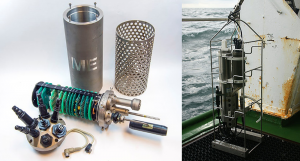
For more accurate measurements, nearly oceanographers use an instrument that measures electrical conductivity. An electrical electric current is passed between two electrodes immersed in water, and the higher the salinity, the more readily the current will be conducted (the ions in seawater conduct electric currents). Conductivity probes are often arranged into an instrument called a CTD, which stands for Conductivity, Temperature, and Depth, which are the most commonly-measured parameters. Modernistic CTDs can be outfitted with an assortment of probes measuring parameters like calorie-free, turbidity (water clarity), dissolved gases etc. CTDs can be big instruments (below), but small hand-held salinity probes are likewise widely available.
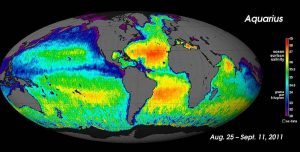
For large-scale salinity measurements, oceanographers tin can employ satellites, such as the Aquarius satellite, which was able to mensurate surface salinity differences as small equally 0.2 PSU equally it mapped the ocean surface every seven days (beneath).
It is important to exist aware that while the rule of abiding proportions applies to most of the ocean, there may be certain coastal areas where lots of river belch may alter these proportions slightly. Furthermore, it is important to call back that the rule of constant proportions merely applies to the major ions. The proportions of the pocket-sized ions may fluctuate, but remember that they brand a very pocket-size contribution to overall salinity. Because the concentrations of the small-scale ions are not constant, these are referred to as .
Why are the major ions found in abiding proportions? There is abiding input of ions from river and other processes, usually in very different proportions from what is plant in the body of water. Then why don't the proportions in the oceans change? Nigh of the ions discharged by rivers accept fairly depression (meet section v.2) compared to ions in seawater, unremarkably because they are used in biological processes. These low residence times practise non allow the ions to accrue and alter salinity. Besides, the mixing time of the world ocean is around 1000 years, which is very short compared to the residence times of the major ions, which may exist tens of millions of years long. So during the residence time of a unmarried ion the ocean has mixed numerous times, and the major ions take become evenly distributed throughout the body of water.
Variations in Salinity
Full salinity in the open bounding main averages 33-37 , but it can vary significantly in different locations. Simply since the major ion proportions are constant, the regional salinity differences must be due more than to water input and removal rather than the addition or removal of ions. Fresh water input comes through processes like precipitation, runoff from land, and melting water ice. Fresh water removal primarily comes from evaporation and freezing (when seawater freezes, the resulting water ice is mostly fresh water and the salts are excluded, making the remaining h2o even saltier). And then differences in rates of precipitation, evaporation, river discharge, and ice formation play a pregnant role in regional salinity variations. For example, the Baltic Bounding main has a very low surface salinity of effectually 10 ppt, considering it is a mostly enclosed body of water with lots of river input. Conversely, the Red Sea is very salty (effectually xl ppt), due to the lack of precipitation and the hot surround which leads to high levels of evaporation.
1 of the saltiest large bodies of water on Globe is the Dead Bounding main, between Israel and Hashemite kingdom of jordan. Salinity in the Expressionless Sea is around 330 ppt, which is almost ten times saltier than the ocean. This extremely loftier salinity is a consequence of the hot, barren conditions in the Middle East that atomic number 82 to high rates of evaporation. In addition, in the 1950s the period from the Hashemite kingdom of jordan River was diverted away from the Dead Sea, so there is no longer significant fresh water input. With no input and high evaporation, the h2o level in the Dead Bounding main is receding at a rate of well-nigh i m per year. The loftier salinity makes the h2o very dense, which creates buoyant forces that allow people to hands float at the surface. But the high salinity also means that the water is too salty for near living organisms, so only microbes are able to call it dwelling; hence the name the Dead Ocean. Only as salty as the Dead Sea may be, it is not the saltiest body of h2o on Globe. That stardom currently belongs to Gaet'ale Swimming in Ethiopia, with a salinity of 433 ppt!
Latitudinal Variations
While local weather are important for determining salinity patterns in whatever unmarried location, there are some global patterns that carry farther investigation. Temperature is highest at the equator, and lowest near the poles, so we would expect higher rates of evaporation, and therefore higher salinity, in equatorial regions (Figure five.3.2). This is generally the case, but in the figure below salinity right along the equator seems to be a little lower than at slightly college . This is because equatorial regions also go a high volume of pelting on a regular basis, which dilutes the surface water forth the equator. Then the higher salinities are institute at subtropical, warm latitudes with high evaporation and less precipitation. At the poles there is picayune evaporation, which, coupled with ice and snowfall melting, produces a relatively low surface salinity. The image below shows high salinity in the Mediterranean Sea; this is located in a warm region with loftier evaporation, and the sea is largely isolated from mixing with the rest of the North Atlantic water, leading to high salinity. Lower salinities, such as those around southeast Asia, are the effect of precipitation and high volumes of river input.
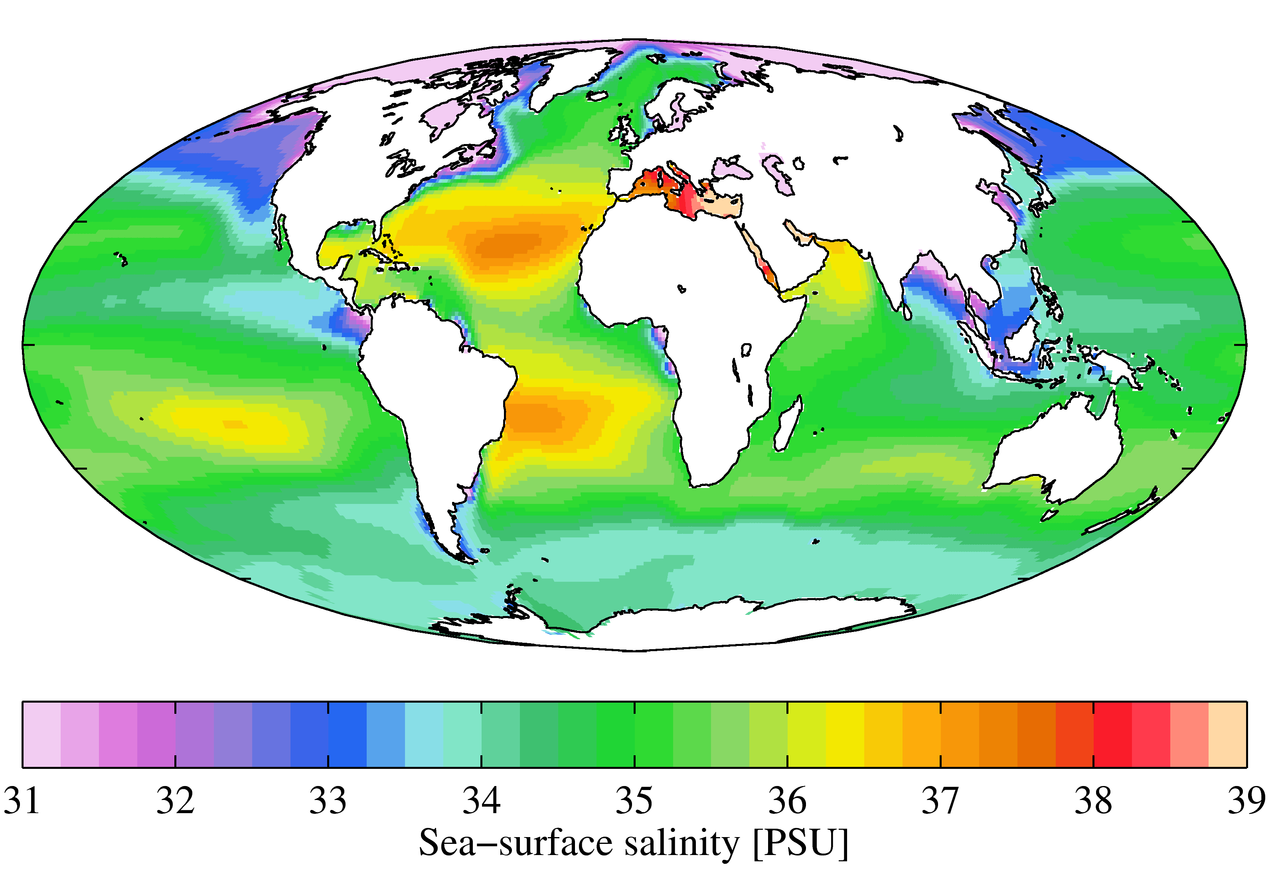
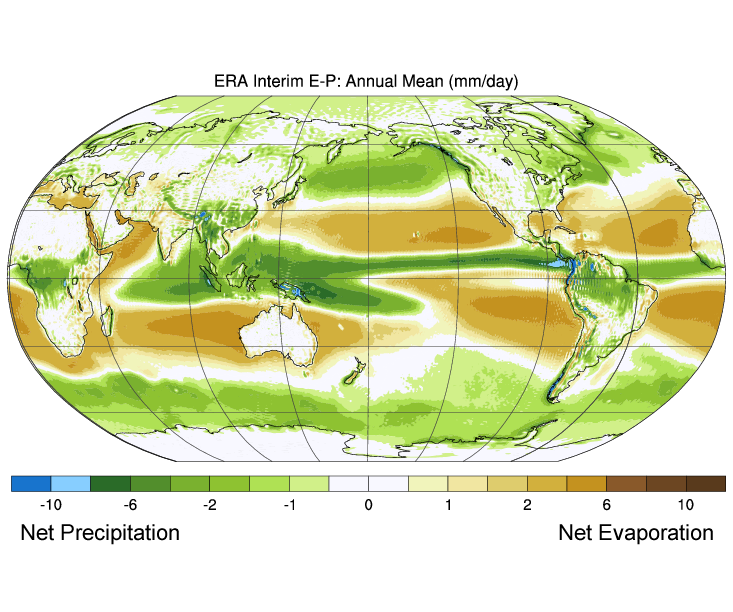
Figure v.iii.iii shows the mean global differences between evaporation and precipitation (evaporation – atmospheric precipitation). Green colors correspond areas where precipitation exceeds evaporation, while brownish regions are where evaporation is greater than precipitations. Note the correlation between atmospheric precipitation, evaporation, and surface salinity as seen in Figure 5.3.2.
Vertical Variation
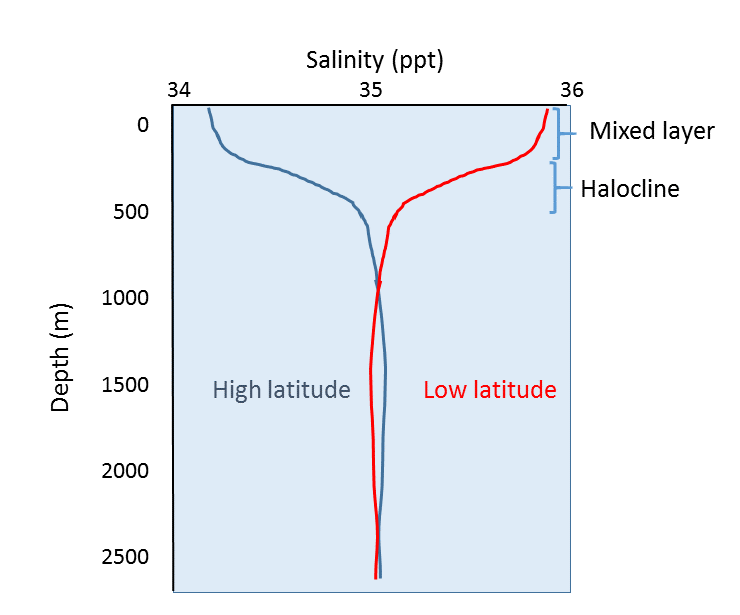
In improver to geographical variation in salinity, there are also changes in salinity with depth. Equally nosotros take seen, virtually differences in salinity are due to variations in evaporation, atmospheric precipitation, runoff, and ice comprehend. All of these process occur at the bounding main surface, not at depth, so the nigh pronounced differences in salinity should exist institute in surface waters. Salinity in deeper h2o remains relatively uniform, as it is unaffected by these surface processes. Some representative salinity profiles are shown in Effigy 5.3.iv. At the surface, the top 200 chiliad or so testify relatively uniform salinity in what is called the . Winds, waves, and surface currents stir upwards the surface water, causing a great bargain of mixing in this layer and adequately uniform salinity conditions. Beneath the mixed layer is an area of rapid salinity alter over a pocket-size change in depth. This zone of rapid change is called the , and it represents a transition between the mixed layer and the deep ocean. Below the halocline, salinity may show petty variation downwards to the seafloor, as this region is far removed from the surface processes that bear upon salinity. In the effigy below, notation the low surface salinity at high latitudes, and higher surface salinity at low latitudes every bit discussed to a higher place. However despite the surface differences, salinity at depth in both locations may be very similar.
Source: https://rwu.pressbooks.pub/webboceanography/chapter/5-3-salinity-patterns/
0 Response to "The Residence Time for Water in Any of Earth's Principal Reservoirs Can Be Calculated by Dividing"
Post a Comment