How Many Calories Is in a Half Cup Raw Baby Carrots
You probably know that there aren't any quick fixes or magic bullets for fat loss or musculus proceeds.
That is, you know that you lot demand to control your calorie intake if you want to lose weight, proceeds muscle, or maintain your weight.
Only how many calories should you eat?
Yous've probably heard that men should consume 2,500 calories per day to maintain their weight and women should eat two,000 calories per 24-hour interval.
The truth, though, is that these numbers but work for some people, some of the fourth dimension.
Inquiry shows that instead of sticking to these (mostly capricious) calorie targets, you lot should optimize your calorie intake for your body, lifestyle, and goals.
And that's what you're going to larn how to do in this article.
By the end of it, y'all're non only going to know how many calories you should eat every mean solar day, but also:
- How to gear up your "macros" to optimize fat loss and musculus proceeds
- How to lose, gain, or maintain your weight eating foods you actually similar
- How unlike food choices affect your ability to lose weight
- And more!
Let'southward get started!
(Or if you lot'd prefer to skip all of the scientific mumbo jumbo, and yous merely want to know how many calories, how much of each macronutrient, and which foods y'all should eat to reach your goals, no problem! Just take the Legion Nutrition Quiz , and in less than a minute, you'll know exactly what diet is right for you. Click here to check it out .)
- What Is a Calorie?
- How Many Calories Should You Consume to Maintain Your Weight?
- Women
- Men
- Children
- How Many Calories You Should Eat
- How Many Calories Should You Eat to Lose Weight?
- How to Turn Your Calorie Target into Macronutrient Targets
- The All-time Way to Count Calories to Lose Weight
- FAQ #1: How can I eat less without feeling hungry?
- FAQ #2: Should I swallow less or exercise more to lose weight?
- FAQ #3: How many calories should I eat to gain musculus?
- FAQ #4: Can I eat more if I exercise more?
Table of Contents
What Is a Calorie?
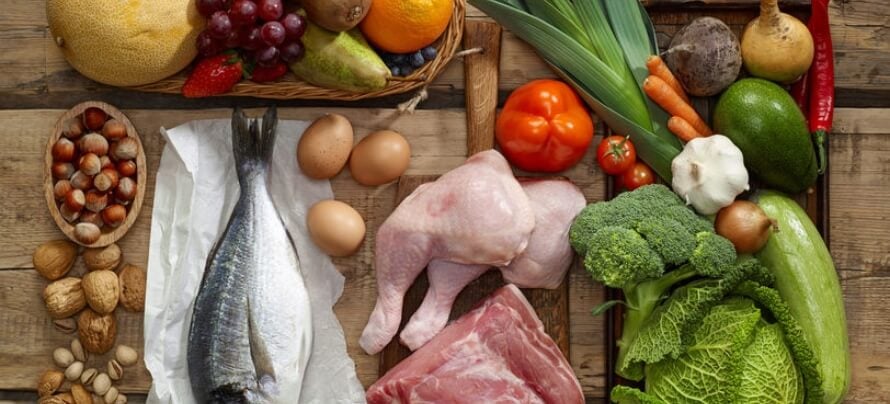
A calorie is a unit of measurement for energy.
One calorie is the amount of energy it takes to heat ane kilogram of h2o one caste Celsius (also called a kilocalorie or Calorie with a capital letter "C").
Nosotros can measure the corporeality of energy contained in food and the corporeality of free energy our bodies burn, in calories.
How Many Calories Should You Eat to Maintain Your Weight?
How many calories you should eat per day to maintain your weight depends on a multifariousness of factors, including your:
- Body weight
- Body fatty percentage
- Activeness levels
- Age
- Diet
- And a few other variables
Thus, the number of calories you demand to maintain your weight is very individual, and also changes over time. That said, you tin commonly arrive at a decent guess of your current calorie needs using just your body weight and activity levels.
Women
Almost women between the ages of 20 and fifty who are physically active (merely not following a workout routine) and at a healthy body weight need to eat around 1,700 calories per solar day to maintain their weight.
Women who are older than 50 sometimes need to eat less than this, more often than not considering they have less musculus mass and are less active . Although your metabolism does reject slightly with age, most of the decrease is due to exercising less and losing muscle mass—not an innate driblet in your metabolism.
The expert news is you can counteract many of the hormonal hindrances associated with menopause that make maintaining your weight more hard by eating a healthy diet and taking regular exercise .
Women who are younger than xx sometimes demand to eat more than this, although their calorie needs vary greatly depending on how active they are. That is, agile young women demand to eat a lot more than sedentary ones. Or in other words, beingness young doesn't necessarily hateful you lot should swallow more than than older folks—information technology depends on your activeness levels.
Ironically, overweight women (a torso mass index of greater than 25) mostly need to swallow more to maintain their weight than normal weight women. This is because your torso burns a off-white number of calories maintaining and moving your excess body weight—sometimes over a thousand calories per day .
Men
Most men between the ages of twenty and 50 who are physically active (but not following a workout routine) and at a healthy torso weight need to eat around 2,200 calories per day to maintain their weight.
Men who are older than 50 often need to consume slightly less than this, as they more often than not accept less muscle mass and are less active. Although your metabolism does decline slightly with age, most of the decrease is due to exercising less and losing muscle mass—not an innate driblet in your metabolism.
Men who are younger than 20 sometimes demand to eat more than this, although their calorie needs vary greatly depending on their activity levels. Simply put, active young men need to swallow a lot more than than sedentary ones. Or in other words, being young doesn't necessarily hateful y'all should eat more than older folks—it depends on your activity levels.
Ironically, overweight men (a trunk mass alphabetize of greater than 25) generally demand to consume more than to maintain their weight than normal weight men. This is considering your torso burns a off-white number of calories maintaining and moving your backlog torso weight—sometimes over a chiliad calories per twenty-four hour period.
Children
Many people recollect that kids tin consume as much as they want without worrying nigh weight gain, merely the staggering rise in childhood obesity puts lie to this notion.
In fact, children more often than not need to eat far less than adults for one uncomplicated reason: they're smaller.
Even if a child is very active, they're still moving effectually a very small amount of weight, so they but don't fire that many calories.
For example, babies but need to eat effectually 80 to 120 calories per kilogram of body weight per day to support healthy development. (For instance, a four-month old, 18-pound/viii-kilogram baby would demand to eat well-nigh 700 calories per 24-hour interval).
The average toddler (1-to-3 yr sometime) only needs to consume about 1,000 calories per day.
And the average "tween" (~4 to 10 years quondam) but needs to eat around ane,200 to ii,000 calories per day depending on their age, body weight, and activity level.
Hither'due south a helpful chart for estimating how many calories your child should eat based on their age, gender, and activity level:
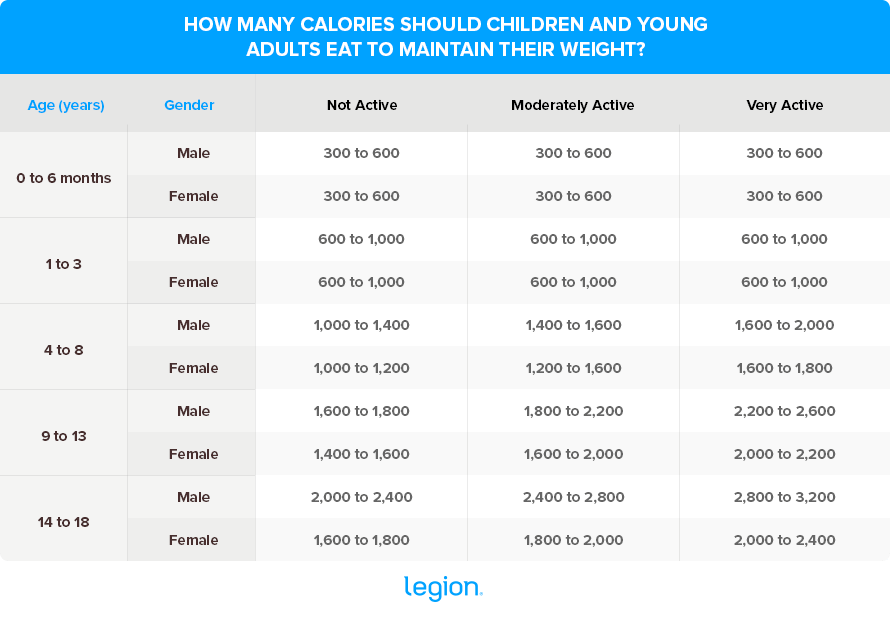
Think, though, that these numbers are just estimates—non exact prescriptions. In fact, counting calories is generally unnecessary (and fifty-fifty counterproductive) for children.
Instead, the best way to make sure they consume enough to support good for you growth and evolution is to provide enough of healthy nutrient options throughout the day, and allow them swallow when hungry and terminate eating when they're full, and make sure they stay active.
How Many Calories Y'all Should Consume
There are three ways I recommend to summate how many calories you lot should eat per mean solar day:
- Enter your gender, weight, height, and historic period in the Legion Calorie Calculator . This is the near accurate method.
- Multiply your weight in pounds by 14 to 16, with women and less agile people using the lower terminate of this range, and men and more active people using the upper stop of this range. This method is slightly less accurate, but more convenient than the first pick.
- Use the charts below to estimate how many calories y'all should eat based on your gender, historic period, and action level. This method is the least accurate, simply also very unproblematic and fast.
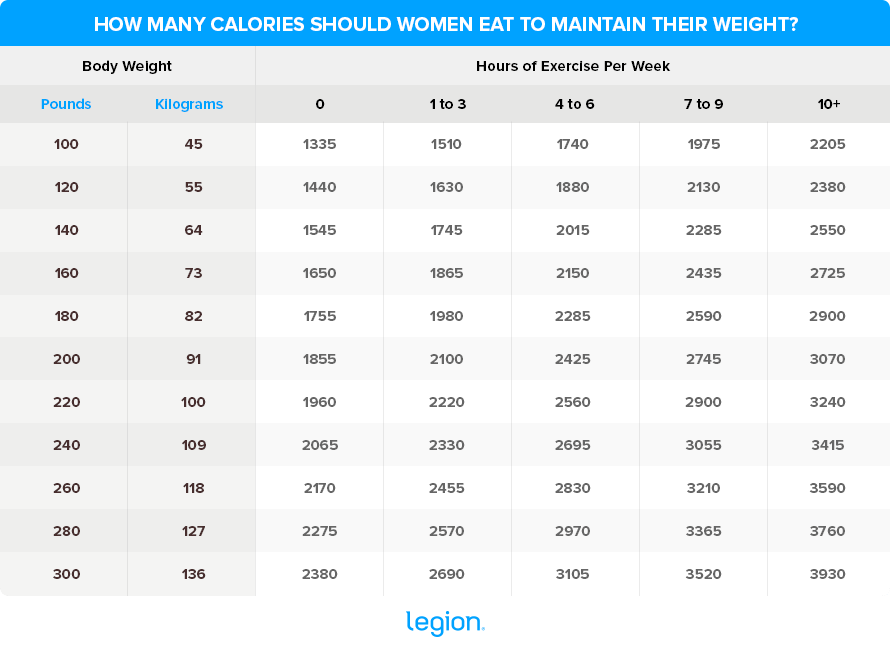
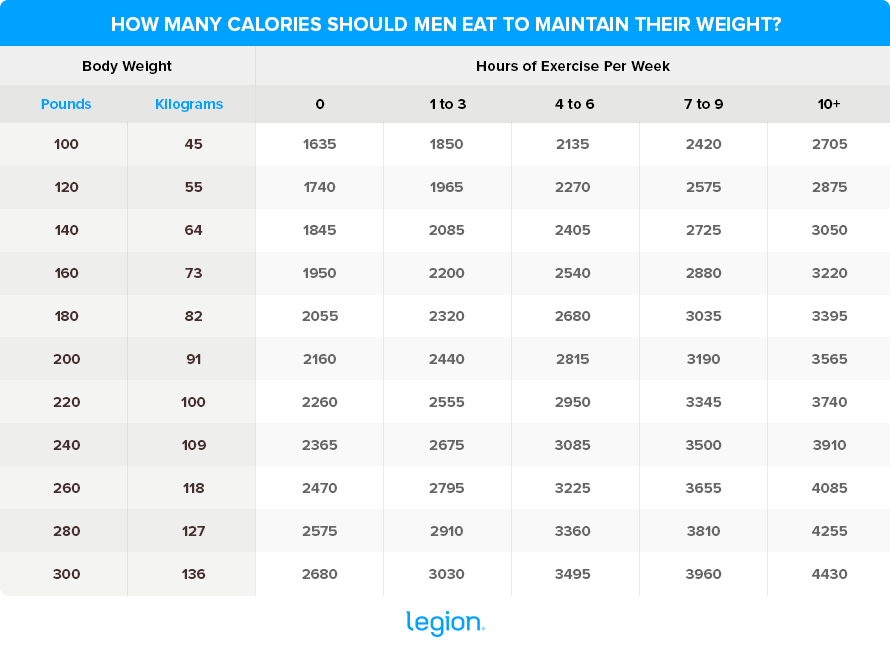
How Many Calories Should You lot Eat to Lose Weight?
Losing weight effectively requires you to walk a tightrope.
You want to cutting your calories plenty and then that y'all experience consistent, encouraging weight loss, simply not so much that y'all start experiencing lethargy, cravings, and muscle loss.
So, what's this magic number?
Well, we can give thanks researchers at the University of Jyväskylä for an reply!
In a study they conducted, the researchers had 15 male person national and international level track and field jumpers and sprinters maintain a daily calorie deficit of 300 calories (~10% deficit) or 750 calories (~24% deficit). Both groups continued with their normal training plan and ate a high-protein nutrition .
After four weeks, the commencement group lost very little fat and muscle, and the second group lost, on average, well-nigh iv pounds of fat and very petty muscle. And neither grouping experienced any negative side effects to speak of.
These findings completely jive with my feel both with my body and the thousands of people I've worked with: a calorie deficit of around 20 to 25% seems to be the sweet spot for losing fat apace without losing muscle, spoiling your mood, or disrupting your operation in the gym.
This works out to a weekly rate of weight loss of virtually 1 to 2 pounds for most people.
How to Turn Your Calorie Target into Macronutrient Targets
Afterwards estimating how many calories you need to maintain your weight, the next footstep is to turn your calorie target into macronutrient targets.
A macronutrient is a food your body needs in relatively large amounts to survive, with the main ones existence poly peptide, carbohydrate, and fatty. In the fitness space, they're generally referred to as "macros."
The reason you want to turn your calorie target into macronutrient targets, is that your macronutrient intake has a meaning touch on on your trunk limerick . In other words, while calories alone dictate how much weight you lose or proceeds, your macronutrient intake largely dictates whether you lose or gain fat or muscle.
Past eating the right amount of protein, carbs, and fatty, you can ensure that virtually of the weight you lose while "cutting" is from fat—not muscle. And as a corollary, you lot tin can likewise ensure that most of the weight y'all proceeds while lean bulking is from musculus, non fat.
The exact number of calories y'all get from poly peptide, carbs, and fat depends on your preferences and goals, only here's what I typically recommend.
When you want to lose weight, get . . .
- 40% of your calories from poly peptide
- 30% of your calories from carbs
- 30% of your calories from fat
These guidelines change slightly if you lot're already lean and looking to get leaner, in which instance it'due south generally best to become 1 to 1.2 grams protein per pound of body weight, 20% of your calories from fat, and the residual from carbs.
When you lot want to maintain your weight or gain musculus, get . . .
- thirty% of your calories from protein
- 30 to 40% of your calories from carbs
- 20 to 30% of your calories from fat
Typically, this works out to around 0.eight to 1.2 grams of protein, 0.75 to i.25 grams of carbs, and 0.2 to 0.3 grams of fat per pound of trunk weight per day for most people.
Once you know what percentage of your calories you want to come from poly peptide, carbs, and fat, open the Legion Macronutrient Figurer to convert these percentages into grams.
Or, you lot can do the math yourself using the post-obit formulas:
Grams of Protein Per Twenty-four hour period = (Full Calories x Percentage of Calories from Protein) / four
Grams of Carbs Per Mean solar day = (Total Calories 10 Percentage of Calories from Carbs) / 4
Grams of Fat Per Day = (Total Calories x Percent of Calories from Fat) / four
For example, if you want to eat 2,000 calories per mean solar day while losing weight, the formulas would look like this:
Grams of Protein Per Day = (ii,000 x 40%) / 4
Grams of Carbs Per Day = (2,000 x 30%) / 4
Grams of Fat Per Day = (2,000 10 30%) / nine
Then, the results would look like this:
- 200 grams of protein per mean solar day
- 150 grams of carbs per day
- ~65 grams of fat per day
For a total of 2,000 calories per solar day.
The All-time Manner to Count Calories to Lose Weight
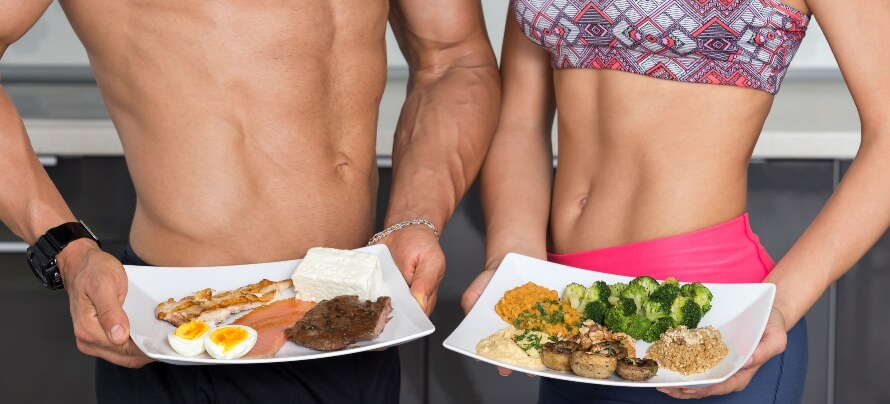
First things first—practise y'all fifty-fifty need to count calories to lose weight?
Non necessarily, but you exercise need to maintain a calorie deficit to lose weight, and counting calories is an effective manner to do this.
That said, most people notice that counting calories on the fly (unremarkably by entering the foods they eat throughout the twenty-four hours into a calorie tracking app) becomes a burden. Y'all inevitably waste fourth dimension debating over what to eat and working out how much y'all can eat and you increase the likelihood of mistakes, like forgetting to log every calorie or mistakenly logging more or less than you actually ate.
Two alternative methods for controlling calories are intuitive eating and meal planning .
Intuitive eating can work well for maintaining your torso composition if y'all're already following a adequately good for you diet, but information technology doesn't work as well for losing weight or establishing good for you eating habits .
Meal planning tends to exist the all-time approach, equally information technology'southward just as constructive for controlling your calorie intake every bit calorie counting (and more constructive than intuitive eating), merely requires less time, energy, and attention and thus tends to be more enjoyable and sustainable.
The first thing yous'll need to create an constructive meal program is a food scale and then y'all can weigh the foods you eat.
While eyeballing portions is amend than nothing, it's also easy to mess upwardly, and particularly when you're aiming for a moderate, relatively minor calorie arrears.
From at that place, you can use a food database like SELF Nutrition DATA , the USDA Food Composition Database , CalorieKing , or an app like MyFitnessPal , MyMacros+ , or Cronometer to plan and proceed track of everything you consume throughout the day.
So, you can use this information to create a repast plan that ensures you can hit your calorie and macro targets eating the foods yous like every single day.
(And over again, if you feel confused about how many calories, how much of each macronutrient, and which foods you lot should eat to attain your goals, take the Legion Diet Quiz to acquire exactly what nutrition is right for you.)
FAQ #1: How tin I eat less without feeling hungry?
The easiest manner to adjourn hunger when cutting is to make some simple changes to your diet.
Assuming you lot're eating plenty of protein, the following tips can assist you control your ambition:
- Eat more fiber (and soluble fiber in particular).
- Drink more water .
- Consume fewer calorie-dense foods . This means eating less cookies, sugary drinks, oils, and fatty meats, and the like, and more vegetables, fruits, legumes, and lean meat and dairy.
- Get plenty sleep
Recommended Reading: eight Ways to Meliorate Hunger Control and Weight Loss
FAQ #2: Should I consume less or exercise more to lose weight?
Both!
Enquiry shows that the most efficient way to lose fat and maintain (or gain) musculus is through a combination of calorie brake and exercise. Specifically, force training is the near beneficial kind of exercise for weight loss, but it'due south besides helpful to do a moderate amount of "cardio" (endurance training) as well.
Recommended Reading: The Best Way to Lose Weight Fast with Practice
FAQ #3: How many calories should I consume to proceeds muscle?
If you lot're new to lifting weights (you've been following a proper forcefulness preparation and nutrition plan for two years or less) you lot should eat enough calories to proceeds nigh 1 to two% of your torso weight per month or 0.25 to 0.5% per week.
The reason it'southward all-time to set weight-gain targets in terms of months instead of weeks, is that the actual corporeality of weight you should be gaining tends to be fairly small. For example, if you're a 160-pound man, 0.25 to 0.v% of body weight per week would exist around 0.4 to 0.8 pounds per calendar week. That's hard to track on a weekly basis, which is why monthly benchmarks are the mode to go (in this instance, 1.6 to three.2 pounds per month).
If y'all're an intermediate or advanced weightlifter (you've been following a proper strength training and diet programme for more than 2 years), y'all should eat plenty calories to proceeds 0.5 to 1% of your torso weight per month.
Recommended Reading: The Ultimate Guide to Bulking Up (Without Simply Getting Fat)
FAQ #iv: Tin can I eat more if I practice more than?
This depends on whether your goal is to lose weight, proceeds weight, or maintain your weight.
If your goal is to lose weight, you lot shouldn't "eat back" the calories yous burn working out. The calories you lot burn from exercise are already taken into account when you gauge your calorie needs using the methods explained in this article. Thus, if you consume more than to recoup for the calories burned during exercise, yous're just reducing the size of your calorie deficit and slowing down your weight loss (or halting it altogether).
If your goal is to gain weight, y'all should estimate how many calories you need to proceeds weight based on your current exercise plan, and then suit equally needed. That is, if y'all aren't gaining weight, gradually increment your calorie intake until you are.
If your goal is to maintain your weight, you should only increase your calorie intake if you start losing weight or significantly increase how much you're exercising per week (which will cause yous to lose weight if you don't eat more).
Recommended Reading: Practiced Question: Should Y'all Eat Back the Calories You Burn down from Exercise?
+ Scientific References
- Iraki, J., Fitschen, P., Espinar, S., & Helms, Due east. (2019). Nutrition Recommendations for Bodybuilders in the Off-Season: A Narrative Review. Sports, 7(7), 154. https://doi.org/x.3390/sports7070154
- Miller, T., Mull, S., Aragon, A. A., Krieger, J., & Schoenfeld, B. J. (2018). Resistance training combined with diet decreases body fat while preserving lean mass independent of resting metabolic charge per unit: A randomized trial. International Periodical of Sport Nutrition and Practise Metabolism, 28(1), 46–54. https://doi.org/10.1123/ijsnem.2017-0221
- Huovinen, H. T., Hulmi, J. J., Isolehto, J., Kyröläinen, H., Puurtinen, R., Karila, T., Mackala, Yard., & Mero, A. A. (2015). Body composition and power performance improved after weight reduction in male athletes without hampering hormonal remainder. Journal of Forcefulness and Conditioning Enquiry, 29(i), 29–36. https://doi.org/10.1519/JSC.0000000000000619
- Ben, X. One thousand. (2008). Nutritional direction of newborn infants: Practical guidelines. In World Journal of Gastroenterology (Vol. 14, Event 40, pp. 6133–6139). Baishideng Publishing Group Inc. https://doi.org/10.3748/wjg.14.6133
- Wen, W., Piao, J., & Zhuo, Q. (2010). [Free energy requirements of children and adolescents]. In Wei sheng yan jiu = Journal of hygiene research (Vol. 39, Issue 6, pp. 790–794). Cambridge University Printing. https://doi.org/10.1079/phn2005791
- Sanyaolu, A., Okorie, C., Qi, Ten., Locke, J., & Rehman, S. (2019). Babyhood and Adolescent Obesity in the U.s.a.: A Public Health Business. In Global Pediatric Health (Vol. six). SAGE Publications Inc. https://doi.org/10.1177/2333794X19891305
- Bhadoria, A., Sahoo, K., Sahoo, B., Choudhury, A., Sufi, North., & Kumar, R. (2015). Childhood obesity: Causes and consequences. Periodical of Family Medicine and Primary Care, 4(2), 187. https://doi.org/ten.4103/2249-4863.154628
- Milanović, Z., Pantelić, S., Trajković, N., Sporiš, 1000., Kostić, R., & James, N. (2013). Age-related decrease in concrete activity and functional fitness among elderly men and women. Clinical Interventions in Aging, 8, 549–556. https://doi.org/10.2147/CIA.S44112
- Hunter, Thousand. R., Singh, H., Carter, S. J., Bryan, D. R., & Fisher, G. (2019). Sarcopenia and Its Implications for Metabolic Health. In Journal of Obesity (Vol. 2019). Hindawi Limited. https://doi.org/10.1155/2019/8031705
- Fothergill, Eastward., Guo, J., Howard, L., Kerns, J. C., Knuth, N. D., Brychta, R., Chen, K. Y., Skarulis, Thou. C., Walter, Yard., Walter, P. J., & Hall, K. D. (2016). Persistent metabolic accommodation vi years afterwards "The Biggest Loser" contest. Obesity, 24(viii), 1612–1619. https://doi.org/10.1002/oby.21538
- Ryan, A. Southward., Ortmeyer, H. K., & Sorkin, J. D. (2012). Exercise with calorie restriction improves insulin sensitivity and glycogen synthase action in obese postmenopausal women with dumb glucose tolerance. American Periodical of Physiology-Endocrinology and Metabolism, 302(1), E145–E152. https://doi.org/10.1152/ajpendo.00618.2010
- Bueno-Notivol, J., Calvo-Latorre, J., Alonso-Ventura, 5., Pasupuleti, 5., Hernandez, A. Five., & Pérez-López, F. R. (2017). Outcome of programmed exercise on insulin sensitivity in postmenopausal women: a systematic review and meta-assay of randomized controlled trials. Menopause, 24(12), 1404–1413. https://doi.org/x.1097/GME.0000000000000936
- Mandrup, C. Thousand., Egelund, J., Nyberg, Yard., Enevoldsen, Fifty. H., Kjær, A., Clemmensen, A. E., Christensen, A. N., Suetta, C., Frikke-Schmidt, R., Steenberg, D. E., Wojtaszewski, J. F. P., Hellsten, Y., & Stallknecht, B. M. (2018). Effects of menopause and high-intensity training on insulin sensitivity and muscle metabolism. Menopause, 25(2), 165–175. https://doi.org/10.1097/GME.0000000000000981
- Mason, C., Foster-Schubert, Thousand. E., Imayama, I., Kong, A., Xiao, L., Bain, C., Campbell, K. L., Wang, C. Y., Duggan, C. R., Ulrich, C. Thousand., Alfano, C. Thou., Blackburn, G. 50., & McTiernan, A. (2011). Dietary weight loss and do effects on insulin resistance in postmenopausal women. American Periodical of Preventive Medicine, 41(four), 366–375. https://doi.org/10.1016/j.amepre.2011.06.042
- Milanović, Z., Pantelić, South., Trajković, North., Sporiš, Chiliad., Kostić, R., & James, Due north. (2013). Historic period-related decrease in concrete action and functional fitness among elderly men and women. Clinical Interventions in Crumbling, eight, 549–556. https://doi.org/10.2147/CIA.S44112
- Dąbrowska-Galas, G., Dąbrowska, J., Ptaszkowski, Thousand., & Plinta, R. (2019). Loftier physical activity level may reduce menopausal symptoms. Medicina (Lithuania), 55(8). https://doi.org/10.3390/medicina55080466
- Hunter, G. R., Singh, H., Carter, S. J., Bryan, D. R., & Fisher, G. (2019). Sarcopenia and Its Implications for Metabolic Health. In Journal of Obesity (Vol. 2019). Hindawi Express. https://doi.org/10.1155/2019/8031705
Source: https://legionathletics.com/how-many-calories-should-i-eat/
0 Response to "How Many Calories Is in a Half Cup Raw Baby Carrots"
Post a Comment